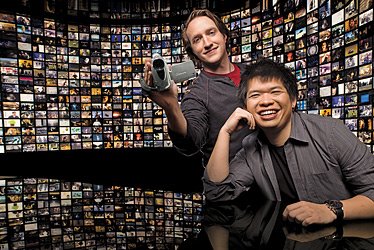
It's really inspiring to see how tech world has changed many ordinary people into superstars with huge wealth... Imagine having a very simple idea and then creating it into a usable form, take it out to the market, then 21 months later, you get paid for $ 1.65 billion. That' how YouTube story is all about...
Steve Chen, 28, and Chad Hurley, 29, two of the three founders of YouTube (the other, Jawed Karim, went to grad school last year).
I gathered some information from the Internet to get to know more about them...
CHAD MEREDITH HURLEY has the lanky and languorous carriage of a teenager who just rolled out of bed. He wears a stubble beard over a complexion that doesn't see enough sun, and he has a habit of pushing his chin-length hair back from his forehead so that by the end of the day it's a bit oily and Gordon Gekko-ish.
Raised in the southeastern Pennsylvania town of Birdsboro, Chad is the middle child of Donald, a financial consultant, and JoAnn, a schoolteacher. He was an arty kid, always watercoloring and sculpting, which is not to say he ran with the artsy crowd. There is nothing affected or capering about Chad—his temperature runs so low he comes off at first as a dullard—and it's easy to imagine him as a slightly introverted, earnest boy trying to sell artwork (not lemonade) from his front lawn, as he did in an unsuccessful venture that taught him the difference between art and commerce.
Chad was unusual in that his artistic proclivities coincided with an interest in business and technology. In ninth grade, he built an amplifier that won third place in a national electronics competition. By the time he was in college, he would hole up for hours online, doing those things boys do these days—studying Web design, playing games, experimenting with animation. He did not come equipped with a sense of entitlement or snobbery; his brother Brent, 27, told me that to earn money during one summer in college, Chad joined a pyramid-marketing scheme for knife sets. "He would come over to our friends' houses and cut through a soda can or something," says Brent. "One of our family friends, they joke now, 'Hey, you sold us these knives and look at you now.'"
STEVE SHIH CHEN has always been something of a risk taker. He left the University of Illinois at Urbana-Champaign a semester and a half early to work for PayPal. His family was wary: "We told him it was risky; he just had a few months left" in college, says his brother Ricky, 26. "But he was determined to give it a shot." Steve was drawn to PayPal partly because several U. of I. alums worked there, including PayPal co-founder Max Levchin, who in turn was eager to hire Steve because of his educational background. Steve had attended not only U. of I.—which has a well-respected computer-science program—but also the Illinois Mathematics and Science Academy (IMSA), a state-funded boarding school. "IMSA plus U. of I. is generally a very winning formula," says Levchin, who says the combination produces "hard-core smart, hardworking, nonspoiled" young engineers who are perfect for start-ups. "The kind of people that imsa attracts are the kind of people very prone to choose their own path," he says. They also grow up quickly, since IMSA feels more like a college than a high school. It's coed and highly competitive, the schoolwork is college level, and kids spend every possible second on the Internet.
Which isn't to say Steve is a geek—at least not an irretrievable geek. Chad gets more attention for his laid-back cool look, but Steve is actually more fun to hang out with, particularly since he started drinking a year and a half ago (right around the time YouTube was founded; he jokingly wonders if there's a connection). Steve seems to wear the responsibilities of the company more lightly than Chad, and he has absorbed less of the heavy p.r. coaching. Steve, for instance, is willing to speculate about what his wealth might mean for him: "It's funny, you know, Chad and I will probably, are definitely at YouTube for the next five years. But you do start wondering, What's next? Now that you have some cash, and it's like, Well, if I could live in any city, where would I live?"
Do you want to be a billionaire too?
Monday, December 25, 2006
YouTube and The Men Behind
Hard Drive Gets Smaller & Thinner
See the picture. We will have in a very short coming future a mega i-Pod with 100 GB capacity?
That's a 100 GB hard drive made by Toshiba, see the AA batery size?
Hard to believe it's already invented and ready to hit the market...
Toshiba's MK1011GAH 1.8-inch hard drive has a 100GB capacity and uses perpendicular recording technology to increase how much data can be stored in a given surface area. The drive here is shown next to an AA battery.
Source: CNET News
This is more detail information from Toshiba
K1011GAH
1.8-inch CE PMR HDD 100.0GB
Toshiba introduces a 100GB 1.8-inch embedded HDD for consumer electronic (CE) devices based on perpendicular magnetic recording (PMR), the MK1011GAH. Enabling some of today's most exciting, small form factor mobile devices, the new mini-drives offer manufacturers significant storage for consumer, commercial and PC applications - such as music players, handheld PCs, PDAs, wearable computers and laptops. Toshiba is committed to grow with developers and users to provide smart computing solutions, backed by Toshiba-renowned quality and technology leadership.
Key Features
100.0 Gigabytes*
Lightweight, only 59 grams
Low Power Consumption
15ms Average Seek Time
100MB/s Ultra DMA Transfer Rate
Zero Insertion Force (ZIF) connector
Stores up to 40,000 songs, 200 hours of video or 3,000 photos**
Wednesday, December 20, 2006
TIME's Person of the Year 2006 - YOU
It's just too hard to resist copying the TIME's report from its website into my blog here. It's against the law, but for me, it's too important to pass. So be it, I copied them here...
This is a monumental moment where web services like MySpace, YouTube and the phenomenon of blogging has turned the Internet world into an almost fully user-generated world. So, according to TIME, it is YOU who made all the story in this world, it is YOU who rule the world, set the trend... What a world to be...
Just read the story, the complete one is in its original website or buy the printed one with a piece of mirror on its cover, weird isn't it?
TIME's Person of the Year 2006 - YOU
In 2006, the World Wide Web became a tool for bringing together the small contributions of millions of people and making them matter.
The "Great Man" theory of history is usually attributed to the Scottish philosopher Thomas Carlyle, who wrote that "the history of the world is but the biography of great men." He believed that it is the few, the powerful and the famous who shape our collective destiny as a species. That theory took a serious beating this year.
To be sure, there are individuals we could blame for the many painful and disturbing things that happened in 2006. The conflict in Iraq only got bloodier and more entrenched. A vicious skirmish erupted between Israel and Lebanon. A war dragged on in Sudan. A tin-pot dictator in North Korea got the Bomb, and the President of Iran wants to go nuclear too. Meanwhile nobody fixed global warming, and Sony didn't make enough PlayStation3s.
But look at 2006 through a different lens and you'll see another story, one that isn't about conflict or great men. It's a story about community and collaboration on a scale never seen before. It's about the cosmic compendium of knowledge Wikipedia and the million-channel people's network YouTube and the online metropolis MySpace. It's about the many wresting power from the few and helping one another for nothing and how that will not only change the world, but also change the way the world changes.
The tool that makes this possible is the World Wide Web. Not the Web that Tim Berners-Lee hacked together (15 years ago, according to Wikipedia) as a way for scientists to share research. It's not even the overhyped dotcom Web of the late 1990s. The new Web is a very different thing. It's a tool for bringing together the small contributions of millions of people and making them matter. Silicon Valley consultants call it Web 2.0, as if it were a new version of some old software. But it's really a revolution.
And we are so ready for it. We're ready to balance our diet of predigested news with raw feeds from Baghdad and Boston and Beijing. You can learn more about how Americans live just by looking at the backgrounds of YouTube videos—those rumpled bedrooms and toy-strewn basement rec rooms—than you could from 1,000 hours of network television.
And we didn't just watch, we also worked. Like crazy. We made Facebook profiles and Second Life avatars and reviewed books at Amazon and recorded podcasts. We blogged about our candidates losing and wrote songs about getting dumped. We camcordered bombing runs and built open-source software.
America loves its solitary geniuses—its Einsteins, its Edisons, its Jobses—but those lonely dreamers may have to learn to play with others. Car companies are running open design contests. Reuters is carrying blog postings alongside its regular news feed. Microsoft is working overtime to fend off user-created Linux. We're looking at an explosion of productivity and innovation, and it's just getting started, as millions of minds that would otherwise have drowned in obscurity get backhauled into the global intellectual economy.
Who are these people? Seriously, who actually sits down after a long day at work and says, I'm not going to watch Lost tonight. I'm going to turn on my computer and make a movie starring my pet iguana? I'm going to mash up 50 Cent's vocals with Queen's instrumentals? I'm going to blog about my state of mind or the state of the nation or the steak-frites at the new bistro down the street? Who has that time and that energy and that passion?
The answer is, you do. And for seizing the reins of the global media, for founding and framing the new digital democracy, for working for nothing and beating the pros at their own game, TIME's Person of the Year for 2006 is you.
Sure, it's a mistake to romanticize all this any more than is strictly necessary. Web 2.0 harnesses the stupidity of crowds as well as its wisdom. Some of the comments on YouTube make you weep for the future of humanity just for the spelling alone, never mind the obscenity and the naked hatred.
But that's what makes all this interesting. Web 2.0 is a massive social experiment, and like any experiment worth trying, it could fail. There's no road map for how an organism that's not a bacterium lives and works together on this planet in numbers in excess of 6 billion. But 2006 gave us some ideas. This is an opportunity to build a new kind of international understanding, not politician to politician, great man to great man, but citizen to citizen, person to person. It's a chance for people to look at a computer screen and really, genuinely wonder who's out there looking back at them. Go on. Tell us you're not just a little bit curious.
Source: TIME.com
Saturday, December 09, 2006
Google Maps Kills?
In the past few days, lots of IT news are covering the death of James Kim, an editor at CNET, the news site I read everyday. I admit that I didn't follow the story too much though. But I was stunned to read a piece of blog entry from Valleywag. You can read it below.
BOGUS: Google takes flak for James Kim's death
You'll probably come across this story a few times, because it is superficially compelling. The short version: the death of James Kim, the CNET editor who died this week in the wintry mountains of southwest Oregon, was Google's fault. The argument: Kim may have put too much trust in the search engine's online maps. Do we know he even asked Google for directions? No, but he might have, according to the authorities. And, while a rival mapping service from Yahoo suggests a longer, safer route from Grants Pass, Google Maps recommends a shortcut that's dangerous in bad weather. People: it's a decent search engine, not the omnipotent being.
I was a heavy user of Mapquest and then Yahoo Maps a few years ago when I was in the US. I travelled quiet a lot driving with my family. We drove almost accross the continent. Must be thousands of miles of roads... Wherever I go, I asked those online map service to "give me directions". I either printed them or store it in my HP Jornada PDA. I never bought a real map, why should I? I think, almost 90% of those electronic computer-generated directions have been right, the rest 5% was just a tiny fraction of mistake, and most mistakes are minor.
After reading that blog, I was just feeling very lucky and blessed by the One up there. What can I say, if Google Maps were around at that time (year 2000-2002), I would have been used it, I trust Google, just like everyone did. Gosh... thank God I am now still alive.
Now, I feel safer, I use no maps anymore. I live in a small city, I know every single street in it, no maps needed. Hopefully it will save my life a little longer, amin...
Source: Vallewag
Archive
- August 2008 (1)
- April 2008 (1)
- July 2007 (2)
- December 2006 (4)
- November 2006 (4)
- August 2000 (1)
- July 2000 (1)